
Less than two hours a week in cushioned shoes. Here’s why that matters, and why “it’s the shoe” is rarely the answer.
I recently had a bit of a squabble with someone on my personal Facebook profile, and I’ve been sitting with it—wanting to share. Just to be clear, the goal here isn’t to single out this person, or talk $h!t about them, but about discussing my take on the issue. And before you ask, yes, I tried to discuss my POV with this person, but there was no willingness to discuss on their end, so I ended it.
Here’s how it started…
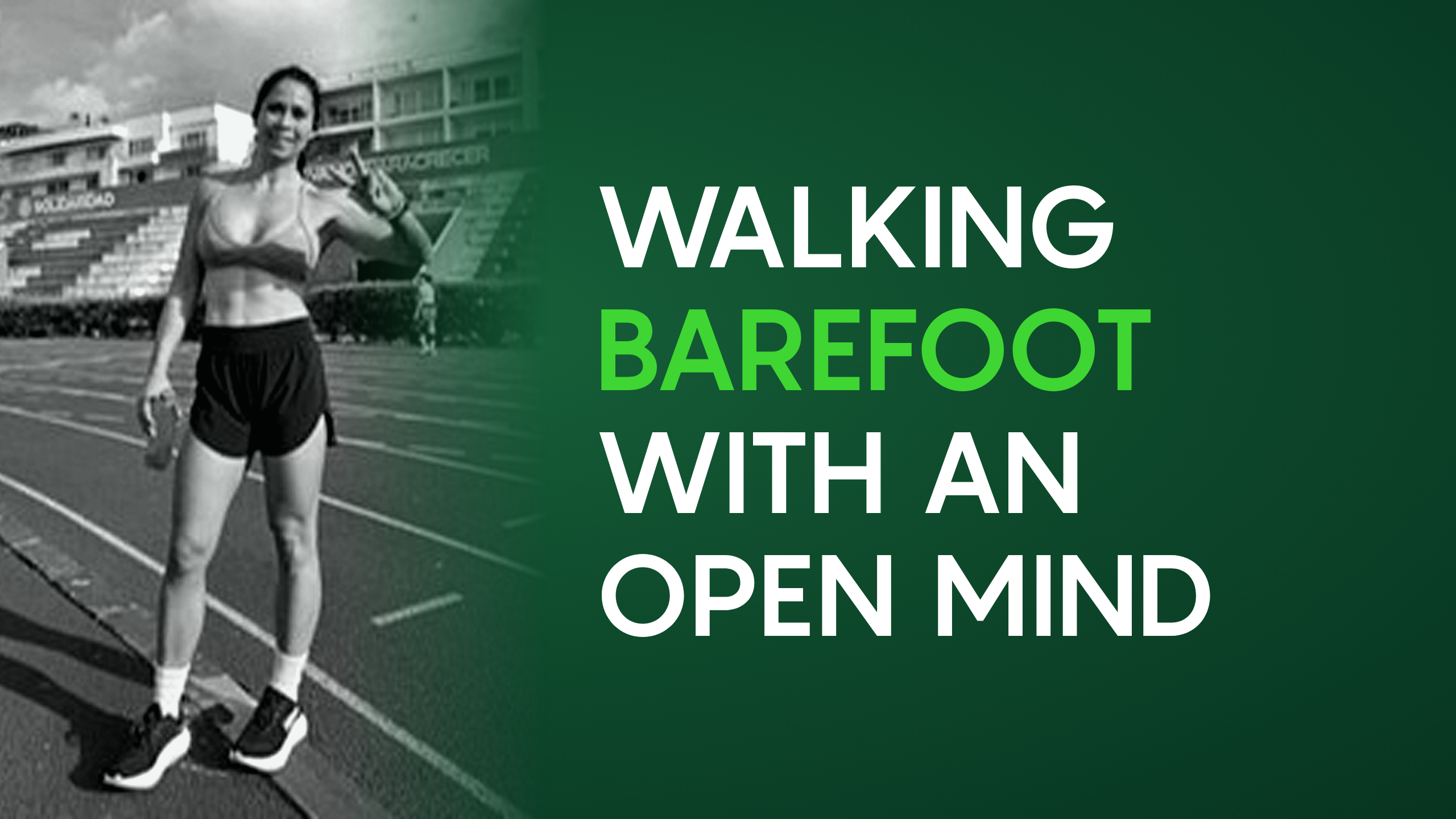
This is me, on the track in Playa del Carmen after a workout run (8 x 600m repeats, to be specific):

The individual essentially responded to the photo with: “Why in the world is a competent physio wearing Hokas??!!”—complete with dramatic punctuation. They went on to claim that Hokas “destroy our proprioception” and shared a series of anecdotes about clients whose pain disappeared “from one second to the next” once they ditched what they referred to as “mattress shoes” (more on that later).
First off, I’m an athletic therapist—not a physio. Just clearing that up.
Second, those who know me know that I am a very peaceful, open-minded, non-confrontational, Buddhism-practicing individual. But when you write to me with a “ ??!! ”, you’ve gotten off to a bad start. (Like, what are you, 14?) Also, you can be super intense about your beliefs and I totally respect that! What I do have an issue with is lack of tact.
I mean, how about:
“I’m curious to know why you choose Hokas for running vs minimalist shoes?”
or
“What are your thoughts on the impact of cushioned shoes on biomechanics and proprioception?”
So, rather than copy-paste my answer here, I figured I would share my thoughts on the various layers of this comment in this article.
(I did tell her not to have the nerve to challenge my professional competence on the sole basis of a shoe choice that she disagrees with despite not having any information about said choice – and on my personal Facebook page to boot!)
But this isn’t just about an internet squabble. It’s a bigger conversation about how we approach training, injuries, and performance—whether we prioritize context and analysis or stick to rigid beliefs.
The Barefoot Ideal: Appreciating It Without Absolutes
For starters, I LOVE being barefoot and always have. I’m half Asian you know. I’ve been on impromptu hikes in Dollar store flip flops, and I’m talking 20+ years ago.
So, you can imagine that when the barefoot ideal became popular, I embraced it.
But I’ve also been an athlete my whole life. I have pretty much played aallllll the sports and trained aaaaalll the ways.
I’ve trained in Adidas boxing boots, Chucks, Vivo Barefoots—and also in just socks or bare feet whenever and wherever I can get away with it.
But I’ve also trained in Rebooks and Nobulls for Crossfit and/or crosstraining because it’s more practical if you also have to push a sled, jump on a box, run, etc.
I hike in minimalist boots. I ran track in spikes. I played flag football in cleats. I’ve done Olympic lifts in lifters.
And I’ve run in running shoes (of many brands, including the infamous Hokas).
Are you starting to see a pattern? I prioritize barefoot, but there are contexts, environments and endeavors that require a different shoe, whether it be for comfort, performance or even just plain personal preference. Like a piece of equipment.
Striking a Balance: When Cushioned Shoes Make Sense
I promised to elaborate on my choice of cushioned shoes, which really should have been the question and should have led to an open discussion.
At the outset, I mentioned that I run in running shoes. I am 47 years old and have been running since like, basically Grade 6 (how old were we in Grade 6?). Over the years, I have run in a variety of brands. Nothing with a huge heel drop and nothing with maximalist cushioning, but not a minimalist shoe, on the other end of the spectrum.
I have also tested how much mileage I can tolerate in minimalist shoes. I have tested how much performance I would sacrifice to run the distance I want to run with the objectives I set for myself, in a minimalist shoe.
I also struggled with insertional Achilles tendinopathy, which took over a year to rehab, and years later it still tends to flare up. That meant I had to change my shoe in order to continue to run and manage the load on my tendon (as you may know, an important part of Achilles rehab is to not stop running completely).
So, I had to increase my heel drop, prioritize cushioning over energy return, and then work my way back down to what I could continue to run in pain-free. And it’s brought me to where I am today, with my choice of a cushioned shoe with a slight heel drop. Because it keeps flaring up, for my tendon, right now, that is the right tool. Whichever direction you are going, transition gradually: in a 12-week trial of runners moving into minimalist shoes, injuries (including shin and calf pain in the fully minimalist group) were common (Ryan et al., 2014). I would apply the same caution to a sudden jump to maximalist shoes.
All this brings me to my next point:
Evidence-based is not just about the Evidence
I’m not gonna pull too much scientific evidence into this article because it is an opinion piece, and also because in this industry, when something is popular, you can find hundreds of articles to back that shit up.
Besides, it’s about balance, not absolutes.
Minimalist or not, no specific running shoe has really been shown to prevent injury.
And research looking at various kinds of shoes fails to show any real effect on injury for shoe technologies such as cushioning, pronation control or heel drop (Relph et al., 2022; Malisoux et al., 2016), so to make the claim that a specific type of shoe can cause injury isn’t well supported by the current evidence.
A couple of things that do appear to emerge from the evidence:
- rearfoot striking with a stiffer, more extended leg sends a lot of additional force up the kinetic chain
- midfoot and forefoot striking with knees bent and feet positioned under the hips creates a softer, more compliant gait
The touted advantage of minimalist shoes is that they tend to promote a forefoot or midfoot striking gait. On the other hand, a maximalist shoe may tend promote a rearfoot striking gait, especially if it is stiff.
But just because it might, doesn’t mean it will. It depends on who you are dealing with.
Running gait and form actually matter more than the shoe. It’s the healthier, more efficient running stride that matters, and this can be accomplished in a wide range of shoes. Or tested to find the right shoe for the right person.
Even the strike pattern isn’t a simple fix. A systematic review concluded that changing the strike pattern can’t be recommended for an uninjured rearfoot striker (Anderson et al., 2020), while a higher step rate lowers the knee and hip energy absorbed per step (Heiderscheit et al., 2011). So cadence and a quiet landing may be a better focus than where the foot lands.
Because one thing always remains (and I find I have to keep reminding people of this): evidence-based practice is not just about the evidence.
It’s also about client/patient characteristics, state, needs, values, preferences, etc. It’s about how you, as an experienced professional, apply the science to the current situation to analyse and make decisions.
Don’t Let Dogma Impair Your Decision-Making
As the conversation continued with this individual, their stance became even clearer — and more rigid. In an attempt to reinforce their argument, they proceeded to share multiple client examples in which pain was supposedly resolved simply by abandoning Hokas — as mentioned earlier, a shoe they repeatedly referred to as “mattress shoes.”
They shared a series of anecdotes claiming that clients who wore Hokas experienced shin splints, knee pain, and hip pain — and that in every case, simply switching to firmer, less cushioned shoes led to immediate and complete resolution of symptoms. In their words, the pain was gone “from one second to the next.” They described scenarios where clients discarded Hokas and were suddenly pain-free, only to have symptoms return just as suddenly if they put the shoes back on. No other contributing factors were acknowledged — not training load, gait mechanics, injury history, or activity type. Just a repeated narrative that Hokas were the sole culprit and that switching shoes was a cure-all.
I see a couple of glaring issues here.
First, I’d bet that switching shoes wasn’t the only thing these clients did. And let’s not even get started on the claim that pain disappeared “from one second to the next.” That alone raises red flags.
Second, there’s zero context—no mention of training load, running experience and efficiency, previous injuries, or even the onset of pain. The entire focus (or should I say, obsession) is on the Hokas, as if they exist in a vacuum.
Third, I don’t care how many clients with pain were wearing Hokas—if your thinking stops at “It’s the Hokas,” you’re missing the bigger picture. Pain and injury are multifactorial. The moment you latch onto a single cause, you blind yourself to all the other factors at play.
Know what it’s called when someone clings to a belief and refuses to discuss it rationally? A dogmatic attitude.
When people become fixated on a single explanation—like blaming Hokas for every pain and injury—they stop looking at the bigger picture. Instead of asking why something is happening, they jump straight to a conclusion that fits their narrative. And that kind of thinking? It’s a dead end.
As professionals (or just thoughtful humans), our job isn’t to impose personal biases but to analyze, adapt, and problem-solve. Dogma clouds judgment. And when that happens, we don’t just limit our ability to help others—we fail to see the full picture ourselves.
Bottom line: it’s not about Hokas. It’s not about barefoot. And it’s definitely not about who can shout the loudest on the internet.
It’s about context. Goals. Experience. Understanding the full picture before making bold claims—or worse, assumptions. We’re not here to follow dogma. We’re here to learn, test, adapt, and yes—sometimes change our minds. That’s what growth looks like.
So no, my proprioception isn’t being destroyed.
And no, wearing Hokas doesn’t make me less competent.
The world isn’t black and white. And neither are shoes (well, my Hokas are but you know what I mean).
References
- Relph N, et al. Running shoes for preventing lower limb running injuries in adults. Cochrane Database Syst Rev. 2022;8:CD013368. doi:10.1002/14651858.CD013368.pub2
- Holowka NB, et al. Foot strength and stiffness are related to footwear use in a comparison of minimally- vs. conventionally-shod populations. Sci Rep. 2018. https://pmc.ncbi.nlm.nih.gov/articles/PMC5829167
- McKeon PO, Hertel J, Bramble D, Davis I. The foot core system: a new paradigm for understanding intrinsic foot muscle function. Br J Sports Med. 2015;49(5):290.
- Lieberman DE, Venkadesan M, Werbel WA, et al. Foot strike patterns and collision forces in habitually barefoot versus shod runners. Nature. 2010;463(7280):531-535. doi:10.1038/nature08723
- Daoud AI, Geissler GJ, Wang F, Saretsky J, Daoud YA, Lieberman DE. Foot strike and injury rates in endurance runners: a retrospective study. Med Sci Sports Exerc. 2012;44(7):1325-1334. doi:10.1249/MSS.0b013e3182465115
- Bittencourt NFN, Meeuwisse WH, Mendonça LD, Nettel-Aguirre A, Ocarino JM, Fonseca ST. Complex systems approach for sports injuries: moving from risk factor identification to injury pattern recognition. Br J Sports Med. 2016;50(21):1309-1314. doi:10.1136/bjsports-2015-095850
- Sackett DL, Rosenberg WMC, Muir Gray JA, Haynes RB, Richardson WS. Evidence based medicine: what it is and what it isn’t. BMJ. 1996;312(7023):71-72. doi:10.1136/bmj.312.7023.71
- Ridge ST, et al. Walking in minimalist shoes is effective for strengthening foot muscles. Med Sci Sports Exerc. 2019;51(1):104-113. doi:10.1249/MSS.0000000000001751
- Ryan M, et al. Examining the effect of transitioning to partial or full minimalist running shoes on injury (12-week randomised trial). Br J Sports Med. 2014. [volume/pages to confirm]
- Malisoux L, Chambon N, Urhausen A, Theisen D. Influence of the heel-to-toe drop of standard cushioned running shoes on injury risk in leisure-time runners: a randomized controlled trial with 6-month follow-up. Am J Sports Med. 2016;44(11):2933-2940. doi:10.1177/0363546516654690
- Anderson LM, et al. What are the benefits and risks associated with changing foot strike pattern during running? A systematic review and meta-analysis. Sports Med. 2020;50(5):885-917. doi:10.1007/s40279-019-01238-y
- Heiderscheit BC, Chumanov ES, Michalski MP, Wille CM, Ryan MB. Effects of step rate manipulation on joint mechanics during running. Med Sci Sports Exerc. 2011;43(2):296-302.

Mai-Linh Dovan M.SC., CAT(C)
Certified Athletic Therapist
Founder of Rehab-U


Be part of the conversation