
Most rehab assessments are designed to answer one question:
“What do I need to work on?”
Where’s the pain? What’s weak? What’s stiff? What movement isn’t working properly?
And all of that information can be extremely useful…for you.
But here’s the problem:
Your client may get very little value from this information, and from the assessment itself.
They come in with a problem. You assess them. You identify a few impairments.
And then you say:
“Okay, here’s what we’re going to work on today.”
You’ve learned a lot.
But what have they learned?
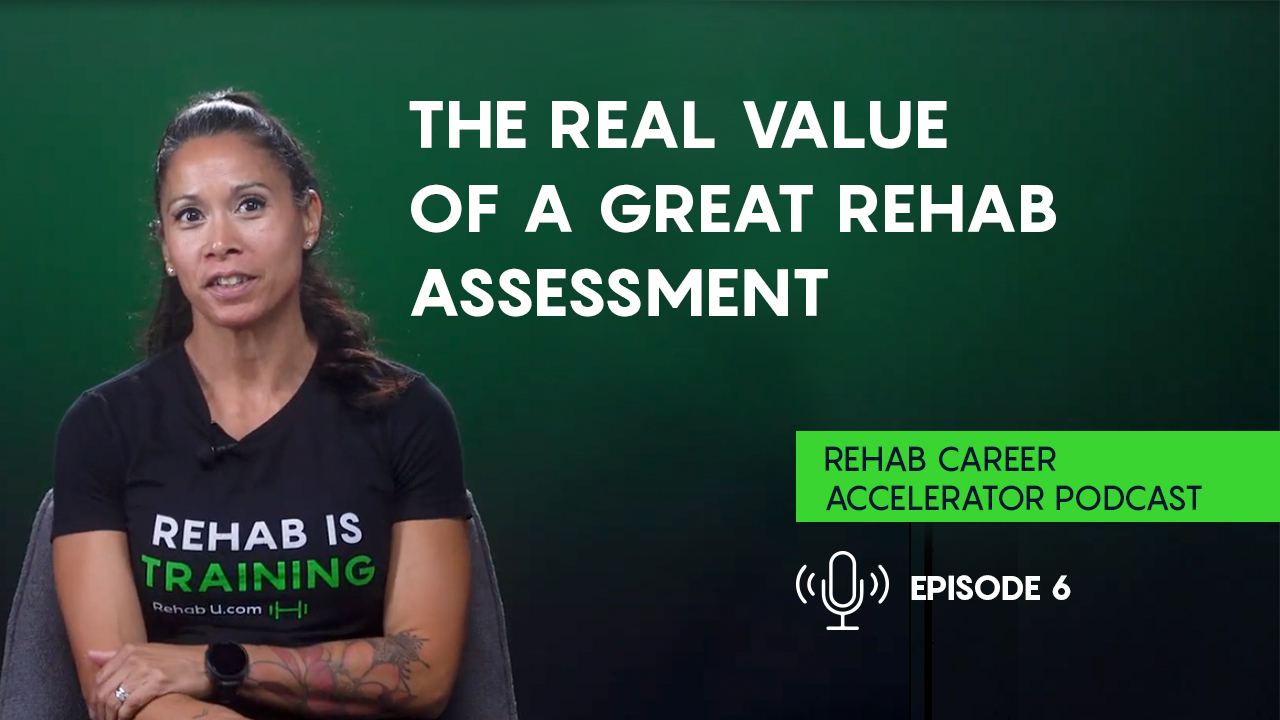
🎙️WATCH THE FULL EPISODE TO GET ALL THE DETAILS
THE ASSESSMENT SHOULD DO MORE THAN GUIDE YOUR INTERVENTION
A great assessment shouldn’t simply help you decide what treatment, intervention or exercise comes next.
It should help you understand the person in front of you — not just their pain or injury.
Yes, you need to understand:
What’s happening.
Why it may be happening.
What needs to change.
But you also need to understand:
Where does this person actually want to go?
Because “I want my knee to stop hurting” isn’t necessarily the transformation they’re looking for.
Maybe what they really want is to run their first half-marathon again.
Maybe they want to get back on the soccer field.
Maybe they want to squat without constantly worrying about their knee.
Maybe they simply want to hike with their family without wondering whether they’re going to pay for it the next day.
And sometimes, the client/patient hasn’t even clearly articulated that yet.
They’ve spent so much time focused on the problem — the pain, the injury, what they can’t do — that no one has really asked them:
“If we do this successfully, what does success actually look like for you?”
That’s part of your job during the assessment too.
Help them verbalize the transformation they’re actually looking for.
Because once you understand where they are and where they want to go, you can start building the bridge between those two points.
And importantly, you can help them see that bridge too.
That’s why in the Rehab Career Accelerator, we work on building an assessment that has three jobs.
EVALUATE → EDUCATE → PLAN
First: Evaluate.
Yes, you still need to gather information.
Their history. Their symptoms. Their movement. Their strength. Their capacity. Their limitations. Their goals.
But that’s only step one.
Second: Educate.
This is where you start creating value for the client.
And education doesn’t simply mean telling them:
“You have limited ankle dorsiflexion.”
Or:
“Your quad is weak.”
It starts with helping them feel that you actually understand their problem — sometimes at a level they haven’t experienced before.
That often begins with the questions you ask.
You’re not only asking:
“Where does it hurt?”
You’re asking: What can you no longer do because of it? What happens when you try to train? What have you already tried? What have other professionals told you? What do you think is wrong? What are you afraid might happen if you load it?
Sometimes, simply asking better questions creates value because the client starts thinking:
“No one has ever asked me that before.”
Then, once you’ve assessed them, reflect what you’ve learned back to them.
Connect the dots between their history, their symptoms, what they’ve already tried, what you found in your assessment and what they’re ultimately trying to accomplish.
And help them understand their problem differently.
Maybe they’ve spent the last six months thinking they have a “bad knee” that needs to be protected.
They’ve been told to avoid certain movements, rest when it hurts and strengthen their quads.
But their goal isn’t simply to have less knee pain.
They want to run again.
And your assessment helps them understand that the problem may not simply be whether their knee hurts today.
Their knee may tolerate basic loading perfectly well — but they haven’t yet rebuilt the strength, load tolerance and capacity required to handle the demands of running.
Suddenly, you’re having a very different conversation.
You’re not just saying:
“Here’s what’s wrong with you.”
You’re saying:
“Here’s what I think has been missing from the process so far.”
That’s incredibly valuable.
Because you’re not simply identifying another deficit.
You’re giving them a new way of understanding why they may still be struggling — and what needs to happen differently if they want a different outcome.
And that’s when the assessment starts creating confidence that this process might actually be different from what they’ve already tried.
And finally: Plan.
Show them what needs to happen next.
What is the path from here to there?
What do you need to address first?
What will you build next?
How will you know they’re ready to progress?
Now the client doesn’t just have a diagnosis, an exercise or today’s treatment.
They have a roadmap.
AND THAT CHANGES THE VALUE OF WHAT YOU’RE OFFERING
This is where the assessment becomes more than an intake tool.
And to do this well, I don’t think the assessment should simply be squeezed into the beginning of a treatment or training session.
It should be a service in itself.
For the type of rehab we’re talking about, I like a dedicated, in-depth assessment — often around an hour — where the entire purpose is to understand the person, their history, their problem, their goals and the demands of what they ultimately want to return to.
You’re not rushing through a few tests because you need to leave enough time to “do something” before they leave.
The assessment is doing something.
You’re asking questions they may never have been asked before.
You’re digging deeper into what they’ve already tried and why it may not have gotten them where they wanted to go.
You’re assessing the capacities that actually matter for their goals.
You’re helping them understand what you see.
And then you’re using all of that information to build a roadmap.
Because when someone understands:
where they are → where they want to go → what’s currently standing between those two points → and how you’re going to help them bridge that gap…
the conversation about your service changes.
You’re no longer simply offering something for today.
You’re able to say:
“Based on everything we’ve looked at today, here’s what I think needs to happen over the next 16 weeks to get you back to what you want to do.”
That’s a very different level of value than:
“Here’s what we’ll work on today, and we’ll see how you’re doing next week.”
You’re giving them clarity.
You’re giving them a strategy.
You’re giving them a structured path toward an outcome they care about.
And that naturally leads into a higher-value service because the service itself has become bigger than an appointment.
You’re helping them achieve a transformation over time.
AND THERE’S ANOTHER BENEFIT: ENGAGEMENT
And there’s another reason I think this matters so much:
When clients/patients understand why they’re doing something and where it fits within the bigger plan, they’re much more likely to engage in the process.
The exercise isn’t just:
“3 sets of 10 because my trainer / therapist told me to.”
They understand what capacity they’re building and what that capacity will eventually allow them to do.
And when progress isn’t perfectly linear, they have context for that too.
They’re no longer just following instructions.
They’re participating in a plan they understand.
And that creates confidence in the process.
More confidence creates more buy-in.
More buy-in creates better adherence.
And better adherence gives you a much better opportunity to create the outcomes you’re both working toward.
So the value of a great assessment isn’t limited to that first hour.
It can change the way the client/patient engages with the entire rehab process that follows.
So yes, your assessment should help you identify the problem and choose the right interventions.
But that’s only part of its value.
Evaluate. Educate. Plan.
Reflect your findings.
Connect the dots.
Give them a new understanding of their problem.
And show them the path from where they are to where they want to be.
Because the best assessment doesn’t just tell you what to do next.
It makes the client understand why what comes next matters.
And that’s where the value of your service really begins.
Want to integrate more structured rehab programming into your practice?
If you’re a trainer or therapist looking to take your career to the next level, check out the Rehab Career Accelerator.
If it looks like it could be a good fit, book a quick 20-minute call with our team to discuss your goals, your practice and whether the Accelerator is right for you.
(20-minute call. No pressure, no obligation.)

Mai-Linh Dovan M.SC., CAT(C)
Certified Athletic Therapist
Founder of Rehab-U


Be part of the conversation