
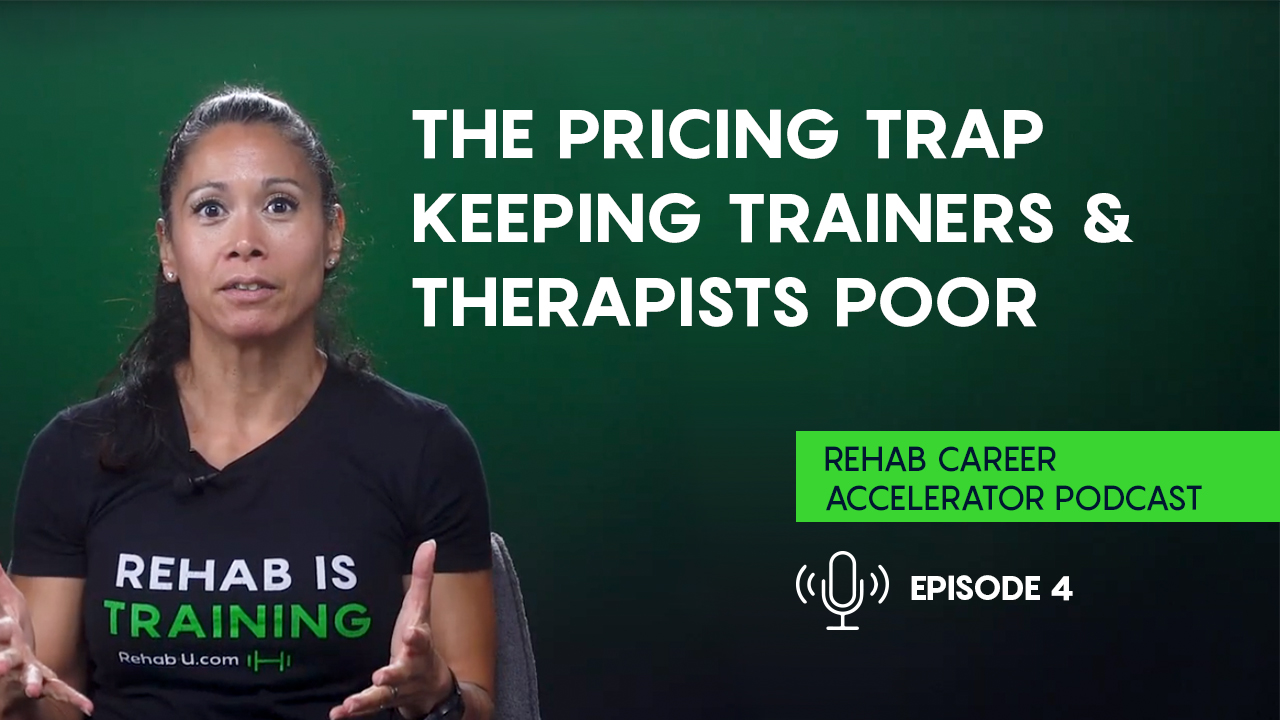
“How much should I charge per hour?”
It’s one of the most common questions trainers and therapists ask when they start thinking about earning more.
Should I charge $75? $100? $150?
What are other trainers charging in my area?
What are other therapists charging?
And I think we spend way too much time trying to find the right answer to what might actually be the wrong question.
🎙️ MAKE SURE TO WATCH THE FULL PODCAST EPISODE TO GET ALL THE DETAILS
Because the moment you ask:
“What should I charge per hour?”
You’ve already made an assumption about what you’re selling: Your time.
And I think that’s one of the biggest reasons so many talented trainers and therapists are undercharging for what they do.
Not necessarily because their hourly rate is too low.
But because they’re trying to put an hourly price on something much more valuable than their time.
WE’VE BEEN CONDITIONED TO THINK IN HOURS
Think about how most of us start our careers.
As a personal trainer, you sell sessions.
One hour of personal training costs $75.
Maybe you offer a package of 10 sessions at a slight discount.
As a therapist, it’s essentially the same thing.
A 30-minute appointment. A 60-minute assessment. A treatment session.
And naturally, when you want to earn more, you start looking at those numbers.
Maybe I should increase my rate from $90 to $100.
Maybe I can charge $110 because I’ve taken another certification.
Maybe once I have five more years of experience, I’ll feel comfortable charging $125.
So over time, we start equating our professional value with a unit of time.
But there’s a problem with that.
The person coming to you doesn’t actually care what an hour of your time is worth.
They’re coming to you because they have a problem they want solved.
The runner wants to run again.
The athlete wants to get back on the field.
The lifter wants to train without constantly worrying about their shoulder.
That’s what they value.
WE ALSO TEND TO UNDERVALUE WHAT WE ACTUALLY BRING TO THE TABLE
And even when we recognize that we have expertise, I think a lot of professionals still struggle to put a value on it.
Virginie is a great example.
When we started working with her through the Rehab Career Accelerator, one of the things holding her back was the fact that she had “only been certified for two years.”
She didn’t feel like she had enough experience yet to charge more.
And if the only thing we looked at was the number of years she’d held her Athletic Therapy certification, maybe that would make sense.
But that wasn’t the full picture.
Virginie was also a strength coach.
She was a former high-level soccer player.
She had personally gone through three ACL injuries.
She understood what it was like to be an athlete trying to come back from a major injury.
She understood programming and performance.
And she had her own personality and ability to connect with the athletes she wanted to help.
All of that has value.
Your credentials matter.
Your years of experience matter.
But they’re not the only things that determine your value.
Your lived experience matters.
Your ability to understand a particular person or problem matters.
Your results matter.
And most importantly:
What all of that allows you to help someone accomplish matters.
“BUT NOBODY WILL PAY THAT MUCH”
Emmanuelle had a slightly different version of the same problem.
As an experienced sports physiotherapist, when she came through the Accelerator, she wasn’t necessarily thinking: “I’m not experienced enough.”
She was thinking: “Nobody is going to pay that much.”
She was operating within the conventional healthcare model in France, where she was earning approximately €16 gross for a social insurance covered physiotherapy session.
So when she started developing Get Back in the Game — her personalized rehab service for athletes — and we started talking about charging €250 per month, that felt like a huge leap.
Her initial reaction was: “Nobody in France will pay that much for rehab”.
And I think that statement reveals exactly where we get value wrong.
They’re not paying €250 for a package of sessions.
In her Get Back in the Game program, Emmanuelle assesses the athlete, creates their individualized rehab program, delivers it online, monitors their progress, provides feedback and adjusts it over 16 weeks.
That depth of service is the value.
SO WHAT ACTUALLY CREATES VALUE?
This is something we spend quite a bit of time working on inside the Rehab Career Accelerator.
Because if value isn’t simply determined by the number of minutes someone spends with you, then we need to think differently about what actually creates it.
Start with the problem you’re solving.
How important is that problem to the person?
Then look at the transformation.
Where are you actually helping them go?
There’s your expertise and specialization.
Your experience solving that particular problem.
Your previous results.
The degree of personalization.
Your programming.
Your clinical reasoning and decision-making.
The amount of feedback, communication and support you’re providing throughout the process.
And the comprehensiveness of the service.
There is a very big difference between: “Come see me Tuesday at 3:00 for an hour.”
And: “I’m going to assess where you are today, understand where you want to go, build the roadmap to get you there, program the process, monitor your progress and support you as we progressively work toward that outcome.”
Even if the amount of face-to-face time is lower.
The value isn’t determined by the number of minutes.
It’s determined by what you’re actually taking responsibility for helping that person accomplish.
CHARGING MORE CAN ACTUALLY ALLOW YOU TO PROVIDE MORE
And I think this is especially important in rehab because there’s often discomfort around the idea of charging more.
Rehab professionals in particular can feel like talking about money somehow conflicts with caring about patients.
But let’s go back to Emmanuelle.
When she was earning approximately €16 per reimbursed appointment, the only way to make the economics work was volume.
More patients. More appointments. More hours.
At one point, she had patients booked every 30 minutes and was often managing several people simultaneously.
Compare that with someone paying her €250 per month for Get Back in the Game.
Now she can actually dedicate time to sitting down and thinking about that athlete.
She can build their program. Review their progress. Look at their feedback. Adjust the plan. Think ahead to the next phase.
And progressively prepare them for the demands of their sport.
Charging more didn’t mean giving the patient less.
In her case, it created the economic space to give them a more complete service.
And that’s an important distinction.
We’re not talking about taking the exact same thing you’re already doing, multiplying the price by five and calling it “premium.”
More value has to come with more responsibility for the outcome and a service designed to justify that value.
AND THEN PEOPLE ACTUALLY PAID
And, this is probably one of my favorite parts of both Emmanuelle and Virginie’s stories.
Because both of them had created beliefs about what people would or wouldn’t pay.
Virginie thought:
“I’ve only been certified for two years.”
Emmanuelle thought:
“Patients aren’t going to pay €250 a month for this.”
Virginie went on to create Rebound, a rehab program priced at $1,000.
And Emmanuelle?
She sold more than 20 programs when she launched her Get Back in the Game program.
The market challenged the stories they were telling themselves about their value.
But I want to be careful here.
The lesson isn’t: “Just charge more.”
You can’t pick an arbitrary high number, put the word “premium” in front of your service and expect people to buy it.
You need to solve a meaningful problem.
You need to create a valuable transformation.
And you need to build a service capable of delivering it.
A premium price comes with a premium responsibility to deliver quality.
But when those things are in place, your price no longer needs to be determined by how many minutes you’re physically standing beside someone – which gives you more time to deliver that quality.
STOP ASKING WHAT AN HOUR OF YOU IS WORTH
So if you’re a trainer or therapist undervaluing yourself and undercharging,try asking:
Who am I helping?
What problem am I solving for them?
Where are they today?
Where do they want to go?
What does it actually take to get them there?
What expertise, programming, decision-making, feedback and support am I bringing to that process?
And what would the complete service need to look like for me to deliver that transformation exceptionally well?
Then ask what that service is worth.
Because your value as a trainer or therapist isn’t measured by a unit of your time.
It’s in what your knowledge, experience and expertise allow you to help that person accomplish.
So maybe you’re not undercharging because your hourly rate is too low.
Maybe you’re undercharging because you’re trying to put an hourly price on something much more valuable.
Want to integrate more structured rehab programming into your practice?
If you’re a trainer or therapist looking to take your career to the next level, check out the Rehab Career Accelerator.
If it looks like it could be a good fit, book a quick 20-minute call with our team to discuss your goals, your practice and whether the Accelerator is right for you.
(20-minute call. No pressure, no obligation.)

Mai-Linh Dovan M.SC., CAT(C)
Certified Athletic Therapist
Founder of Rehab-U


Be part of the conversation