
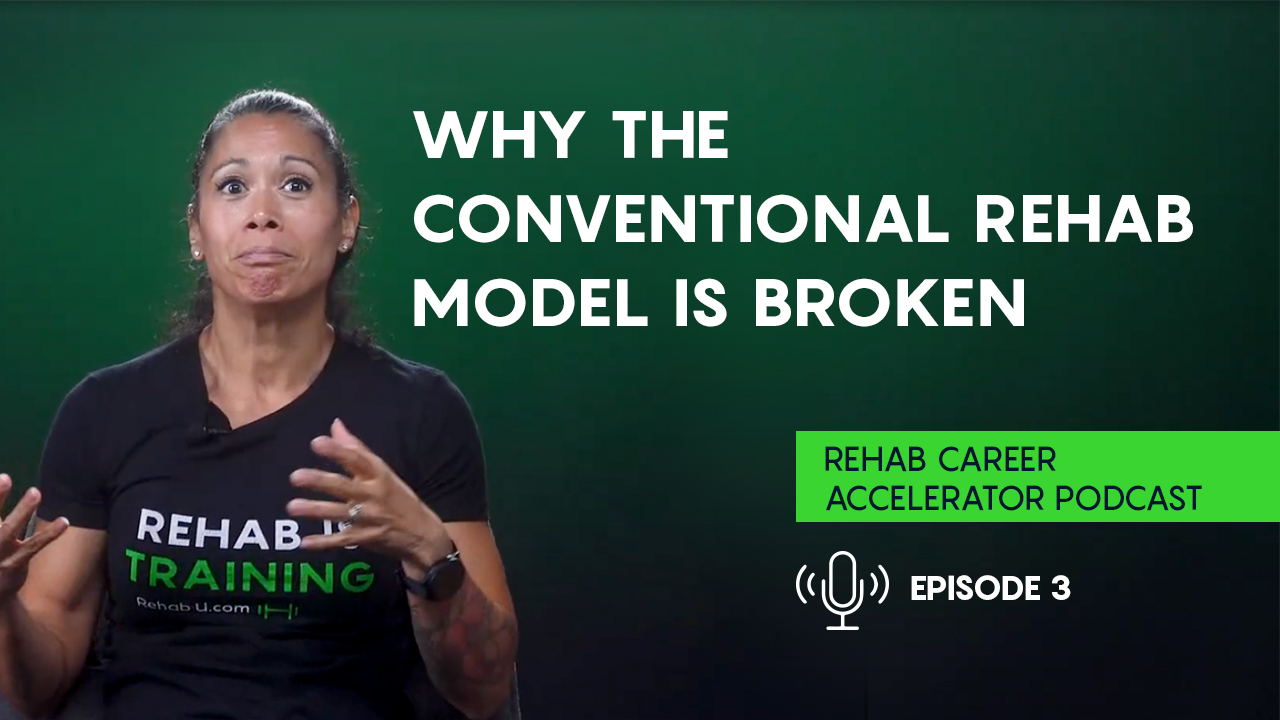
After more than 25 years working in rehab, I’ve come to a conclusion that might sound a little harsh:
The conventional rehab model is broken.
And I don’t say that because I think trainers and therapists aren’t good at what they do.
And I certainly don’t think professionals aren’t trying to provide great care.
Actually, I think the opposite is often true.
There are incredibly talented people trying to do great work inside a system that makes it very difficult to do that work well.
🎙️MAKE SURE TO WATCH THE FULL YOUTUBE EPISODE TO GET ALL THE DETAILS
I know because I’ve experienced this myself AND I’ve coached professionals stuck in this system
And this model that fails both sides.
The professionals working inside it. And the clients and patients they’re trying to help.
Let me explain what I mean.
I EXPERIENCED THIS MODEL MYSELF
I know this model well because I worked in it myself.
When I graduated as an athletic therapist, I started working in a conventional physiotherapy clinic.
And like many young therapists, I was excited.
I finally had the opportunity to use everything I had learned and actually help people get better.
But the reality of working in the clinic looked very different from the way I imagined practicing rehab.
Patients were booked every 30 minutes.
You assess someone. Provide treatment. Give them a few exercises.
Then the next patient arrives. And the next one.
And you’re constantly trying to manage what’s happening today, while somehow also thinking about where this person needs to be weeks or months from now.
I remember feeling frustrated because I knew I could do more.
I didn’t just want to help someone feel a little better after their appointment.
I wanted to take them through the entire process.
- Restore mobility.
- Build strength.
- Progressively load tissues.
- Rebuild capacity.
And eventually get them back to training, sport or whatever they actually wanted to do.
But that takes time. It takes repetition. And most importantly, it takes a plan.
And the session-to-session model makes that very difficult.
The problem wasn’t that I didn’t know how to help people.
The problem was that the model isn’t really designed around delivering the entire rehab process.
There’s also an economic reality we can’t ignore.
In conventional clinical settings, you get paid per appointment.
So if you need to generate more income you need to see more patients.
Your schedule get fuller. Appointments get shorter.
You’re often managing two or three patients at the same time.
The model rewards volume, while good rehab often requires time, planning and progression.
And those two things can come into conflict.
Eventually, there’s a ceiling.
There are only so many patients you can see.
There are only so many hours you can work.
I loved rehab.
I became mentally exhausted.
And despite all those hours, I still felt like I didn’t have enough time to structure the kind of rehab I actually wanted to provide.
So I quit that conventional setting to do rehab my way.
But the consequences of that model don’t stop with the therapist.
The patients feel them too.
PATIENTS ARE FEELING THAT GAP TOO
Because patients are telling us that something is missing too.
At Rehab-U, we receive messages like these all the time.
One person wrote:
“I have a sad record of over 70 physio appointments and $12,000 put on my body to relieve it and try to rehabilitate it this year. That’s crazy.”
Think about that. Seventy appointments. Twelve thousand dollars. And the person is still searching for answers.
Another person told us:
“Sadly, I have been to a lot of therapists in my area. They just do a few exercises and never individualize the program.”
And another, dealing with a long-term rotator cuff injury, contacted us asking:
“Is there a list of physios or other professionals who have been trained in your certification program?”
And I’m not just talking about 2-3 people,
There are tons of people actively looking for something outside of the conventional model.
They’ve spent time.
They’ve spent money.
They’ve seen professionals.
But they’ve never gotten the complete process required to get them where they want to be months from now.
THE FAILURE OF THE MODEL IS ALSO REVEALING AN UNDERSERVED MARKET
And here’s where this gets really interesting.
All of those clients and patients aren’t just frustrated with conventional rehab.
They’re actively looking — and asking — for something different.
The person who has done 70 physiotherapy appointments is still looking.
The person who keeps receiving the same generic strengthening exercises is still looking.
And that tells us something important:
There is a real gap between what people need from rehab and what the conventional model is able to provide.
Not because they necessarily received bad care. We don’t build a better rehab industry by attacking what already exists.
But we do need to pay attention to what’s missing.
And when a group of people has a meaningful problem, is actively searching for a better solution, but can’t easily find someone equipped to provide it…that’s what we call an underserved market.
And I believe the gap between traditional rehab and a complete return to training and performance is one of the biggest underserved markets in our industry.
THE OPPORTUNITY IS IN FINISHING THE JOB
So when I say the conventional rehab model is broken, I’m not saying we need to throw out conventional therapy.
I’m saying there’s a gap in the current model — and an opportunity to fill it.
To me, the future of rehab isn’t more treatments.
And it isn’t simply more exercises either.
It’s a more complete process.
A process where rehab programming is structured over weeks and months rather than improvised appointment by appointment.
Where exercises and training methods are progressed as the person develops more capacity.
Where the demands of their life or sport actually shape the rehab.
And where therapists can actually bridge the gap between treatment and performance.
Because those frustrated patients are looking for someone who can connect the dots.
Someone who can take them from pain and limitation through progressive loading, strength and capacity…
and eventually all the way back to the things they actually want to do.
That’s the model I’ve spent my career building.
Because the goal of rehab isn’t just to get someone out of pain.
It’s to get them back to training. Back to sport. Back to performance — whatever performance means for them.
And that’s where one of the biggest opportunities in rehab is.
Finally finishing the job.
Want to integrate more structured rehab programming into your practice?
If you’re a trainer or therapist looking to take your career to the next level, check out the Rehab Career Accelerator.
If it looks like it could be a good fit, book a quick 20-minute call with our team to discuss your goals, your practice and whether the Accelerator is right for you.
(20-minute call. No pressure, no obligation.)
Mai-Linh Dovan M.SC., CAT(C)
Certified Athletic Therapist
Founder of Rehab-U


Be part of the conversation