
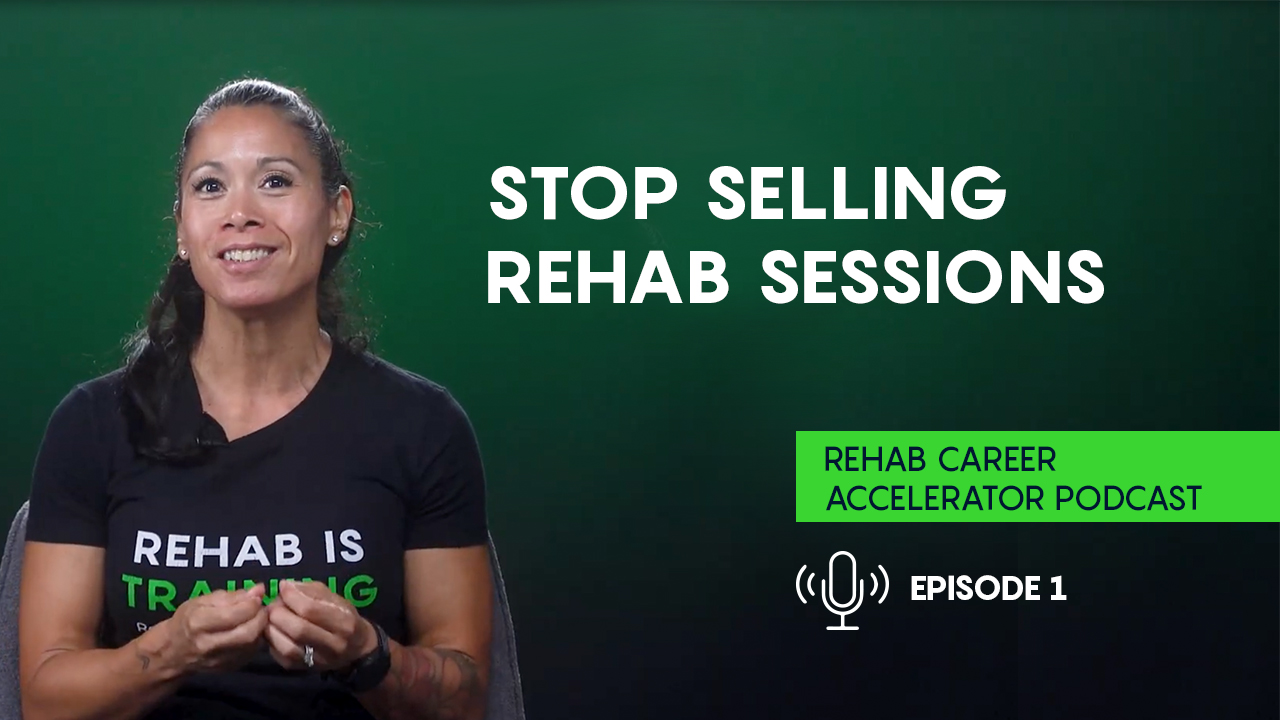
If you’re a therapist or trainer, one of the biggest mistakes you can make in your career is selling your time.
A 30-minute treatment.
A 60-minute training session.
A package of 10 sessions.
Because the person in front of you doesn’t actually want a session.
They want to lift without pain again.
They want to return to their sport.
They want to feel confident using their body again.
They’re not looking for sessions. They’re looking for a transformation.
To get from where they are (in pain or injured) to where they want to be: at their best.
And when I finally understood that, it completely changed the way I approached rehab — and the way I built my career.
WATCH THE FULL EPISODE ON YOUTUBE TO DISCOVER HOW WE HELP TRAINERS & THERAPISTS TURN THEIR REHAB EXPERTISE INTO A MORE VALUABLE, SUSTAINABLE CAREER.
THE PROBLEM WITH THE SESSION MODEL
Think about the traditional way rehab services are sold.
Someone has knee pain.
They book an appointment.
They get assessed, treated,and then:
“Let’s see how you’re doing next week.”
And the process is repeated the following week.
And trainers often do essentially the same thing.
I know because I did it too.
Before I became an athletic therapist, I worked as a personal trainer.
And like pretty much every trainer I knew at the time, I sold sessions.
A client would book an hour with me. I’d plan their workout. We’d train.
And then you’d hope they booked again next week.
And the week after that.
There wasn’t necessarily a bigger roadmap or a defined transformation we were working toward. You were essentially selling the next hour of your time — and hoping the client stuck around.
Then I became an athletic therapist and started working in a clinic.
And strangely enough, even though the setting had changed, the model really hadn’t.
Now instead of training sessions, I was providing treatment sessions.
A patient would come in. I’d assess them. Treat them. Give them some exercises.
And then: “Let’s see how you’re doing next week.”
And I remember feeling frustrated by that because I knew I could help people, but I often felt like I wasn’t really taking them anywhere.
I was helping them with today’s problem…but I wasn’t necessarily guiding them through the entire journey from injury back to the things they actually wanted to do.
And eventually I realized: The problem wasn’t the session itself. The problem was that the session had become the product.
Because rehab doesn’t happen in isolated sessions.
Getting someone from injury all the way back to performance is a process.
You may need to restore mobility. Build strength. Develop tissue capacity. Reintroduce speed. Power. Running. Jumping. Changing direction.
Whatever “performance” means for that individual.
And that process might take 12 weeks. 16 weeks. Sometimes longer.
So I started asking myself: Why are we trying to solve a 16-week problem with a series of disconnected appointments?
And that question completely changed the way I started thinking about rehab.
Not as a collection of sessions…but as a complete process designed to take someone from where they are today to where they actually want to go.
THE SHIFT: FROM SESSIONS TO TRANSFORMATIONS
This shift—from selling sessions to creating transformations delivered in a premium offer —is something we spend a lot of time thinking about and teaching inside the Rehab Career Accelerator.
Because those are two completely different business models.
Imagine someone comes to you with recurring shoulder pain.
Maybe they’ve gotten treatment. Maybe their pain is improving.
But their real goal is to get back to lifting.
You could say:
“My sessions are $100 an hour.”
Or you could do like Amy, one of our Rehab Career Accelerator members, did.
She created Bulletproof Shoulders, a premium 500$ per month rehab program designed to take clients/patients from basic post-rehab strength all the way back to lifting with confidence.
Same professional. Same knowledge. Same person she’s helping.
But a completely different way of packaging her expertise, including
📍 In-person or virtual assessment
📍Phased roadmap from injury to return to performance
📍 Monthly shoulder rehab programming delivered online that they do on their own
📍 High-level personalized support via online check-ins, video feedback, progress assessments and messaging support when they need guidance
And more importantly, a completely different experience for the client/patient.
Because now they understand:
Where they are today,where they are going, what are the steps to get there, and what exactly they’re paying for.
They’re not buying an hour with her, they’re getting a roadmap to get where they want to be.
WHY THIS IS BETTER FOR THE CLIENT/PATIENT
And I want to make something very clear.
This isn’t about taking ten sessions you were already selling, putting them into a package and charging more for it.
That’s still the session model—just bundled differently.
I believe in the premium offer because my experience has shown me that it allows us to deliver better rehab.
Instead of constantly thinking appointment to appointment, you can think in phases.
What does this person need in Phase 1?
What capacities need to be developed before we move to Phase 2?
What are our objective criteria for progressing?
Where should they be four weeks from now? Eight weeks from now? Twelve weeks from now?
Now you’re not just deciding what you’re going to do with them on Tuesday.
You’re designing the entire journey.
WHY THIS IS BETTER FOR YOUR CAREER
And this also changes your career.
Because if your entire income depends on how many individual sessions you can physically fit into your week, eventually you hit a ceiling.
There are only so many hours in a day.
And when the only way to earn more is to work more, it’s very easy to end up with a career you never intended to build:
Early mornings. Late evenings. Back-to-back clients/patients. Working around everyone else’s schedule instead of your own.
And eventually, the work you were once so passionate about can start to feel exhausting.
A premium program gives you another option.
Because you’re being paid for the value of the complete transformation—not just the minutes you spend face-to-face with someone—you don’t have to fill every available hour of your week with appointments.
You can work with fewer people, at a higher level.
You can create space in your schedule for the parts of the work you actually love.
You can have more control over when and where you work.
And you can build your career around your life, instead of constantly building your life around your clients.
That’s where the real value of this model is for me.
Yes, it can allow you to earn more.
But it can also give you something that’s arguably even more valuable:
Time. Freedom. And the opportunity to actually love the work you do again.
RETHINK WHAT YOU’RE ACTUALLY SELLING
So if you’re currently working session to session, I’m not suggesting that you need to throw out EVERYTHING you’re doing.
One-on-one care. Manual therapy. Supervised training: Sessions still have a place.
The question is whether the session is the product—or whether it’s simply one element within a much bigger process.
Because your real value as a rehab professional isn’t the 30 or 60 minutes someone spends with you.
It’s your ability to look at where that person is today, understand where they want to go, and build the process that connects those two points.
That’s your expertise.
And when you start thinking that way, something interesting happens.
You stop asking:
“What should I do with this person at our next session?”
And start asking:
“What needs to happen over the next 12 to 16 weeks to get this person back to what they love doing?”
That’s a much bigger question.
And I think it’s a much better way to practice rehab — because it brings us back to why we chose this profession in the first place.
To guide people through the full process of rebuilding capacity, confidence and performance.
Want to integrate more structured rehab programming into your practice?
If you’re a trainer or therapist looking to take your career to the next level, check out the Rehab Career Accelerator.
If it looks like it could be a good fit, book a quick 20-minute call with our team to discuss your goals, your practice and whether the Accelerator is right for you.
(20-minute call. No pressure, no obligation.)

Mai-Linh Dovan M.SC., CAT(C)
Certified Athletic Therapist
Founder of Rehab-U


Be part of the conversation